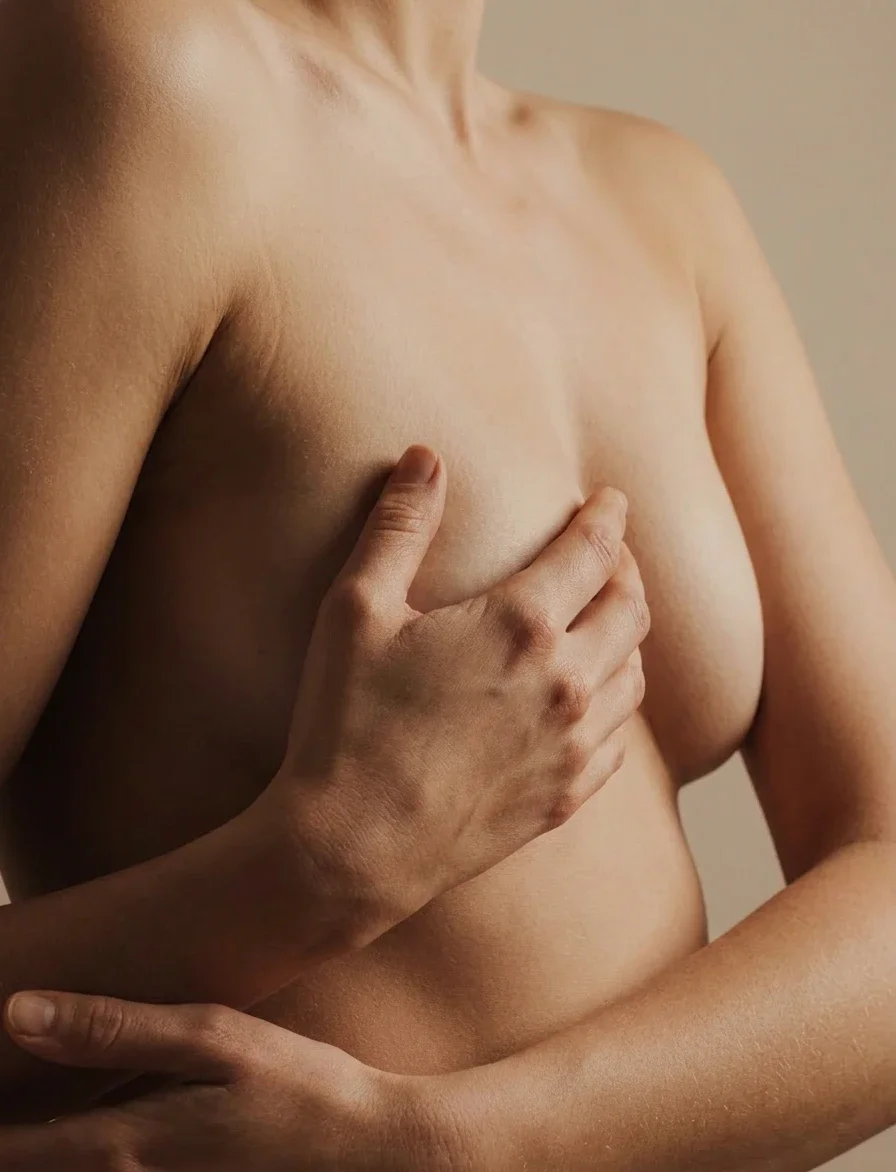
How does asymmetry correction work?
Asymmetry correction uses no fixed technique. Depending on the cause and degree of asymmetry, breast augmentation, breast reduction, breast lift, and lipofilling can be combined.

Asymmetry correction brings the breasts into better proportion when the difference is clearly bothersome.
Mild asymmetry between breasts is normal. When the difference in volume, shape, height, or nipple position is clearly visible, it can cause discomfort in clothing, comfort, or self-image. Asymmetry correction is always bespoke. During the consultation, Dr. Muyldermans assesses which combination of techniques is needed to make the breasts more symmetrical and balanced.
Asymmetry correction uses no fixed technique. Depending on the cause and degree of asymmetry, breast augmentation, breast reduction, breast lift, and lipofilling can be combined.
The treatment can be useful for clear differences in breast volume, shape, nipple position, or excess skin. Asymmetry after development, pregnancy, weight change, or previous surgery can also be discussed.
During the consultation, medical history, clinical examination, and measurements are performed. The final approach depends on your anatomy and what is medically appropriate.
Duration, anesthesia, and recovery are variable because the procedure may consist of lift, reduction, augmentation, lipofilling, or a combination. This is made concrete in advance in your treatment plan.
After surgery, you follow the aftercare of the chosen technique: often support dressing or support bra, check-ups, scar treatment, and avoiding heavy exertion. With combined corrections, recovery may take longer. You receive clear guidance in advance on what to expect, how to prepare, and what follow-up is needed.
Dr. Thomas Muyldermans
Book your consultation hereA clear path with personal guidance, from the first conversation to a beautiful and natural result.

We discuss your request, examine the area, and go through technique, scars, risks, preparation, and recovery for asymmetry correction.
Medication, blood thinners, smoking cessation where needed, and practical planning are reviewed in advance.
The duration of asymmetry correction is variable and anesthesia is determined during the consultation. The technique follows the treatment plan discussed in advance.
Recovery: Depending on technique. You receive instructions for wound care, support garments, pain relief, and activity.
During check-ups, we monitor wound healing, scars, and results and calmly discuss any adjustments if needed.
During asymmetry correction, you feel no pain thanks to the chosen anesthesia. After surgery, tension, tenderness, or swelling may occur. Simple pain relief is usually sufficient, but you receive personal instructions according to the extent of the procedure.
Incisions inevitably leave scars. Dr. Muyldermans places them as discreetly as possible and discusses their location in advance. Scar care with pressure, hydration, silicone, or sun protection may be advised, and a scar usually only settles after months to a year.
Swelling and scars evolve gradually. The early result gives direction, but the final result often takes several months.
Yes. Check-ups are important to monitor wound healing, support garments, sutures, swelling, scars, and results. Timing differs per procedure, but the first check-up is often within the first week or two weeks.
Every asymmetry correction carries possible risks. These include the risks of the chosen techniques, such as bleeding, infection, scars, changes in sensation, asymmetry, and need for revision. We review these carefully in advance and discuss measures to limit them.

Surgiplast Clinic
Choose a reason and a suitable time. Availability and patient details are handled securely by Doctena.
The booking calendar could not be loaded. You can complete your booking securely on Doctena.
Continue to DoctenaDoctena processes appointment data on behalf of Surgiplast Clinic. Read our privacy policy before continuing.
 Book appointment